Better monitoring.
More meaningful insights.
Lihoury Technology is developing a privacy-first AI solution that can transform selected observable aspects of movement, facial expression and voice into quantitative digital virtual markers, giving clinicians and researchers a richer, longitudinal view of their patients.
Turning everyday interaction into useful digital information
Parkinson's disease can change over time, while a clinical consultation provides only a limited snapshot. Lihoury's approach is designed to make selected observable characteristics measurable and repeatable, without requiring dedicated wearable movement sensors.
Objective measurements
Selected movement, facial and voice characteristics can be converted into numerical measurements rather than relying only on subjective observation.
Longitudinal perspective
Repeated assessments can help reveal changes and patterns over time, alongside clinical information and patient history.
Sensor-free interaction
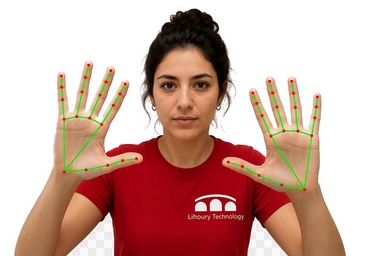
The core approach uses familiar camera and microphone technology, avoiding the need for dedicated wearable movement sensors during the assessment.
A complementary layer of quantitative information
Lihoury Technology is designed to complement — not replace — clinical judgement. By measuring selected digital virtual markers repeatedly, clinicians and researchers may gain additional information to consider alongside established clinical assessments.
- More objective information: quantify selected movement, facial and voice characteristics.
- Repeatable assessments: use standardized tasks to support comparison between sessions.
- Longitudinal monitoring: investigate how measurable features evolve over time.
- Treatment-response research: explore changes associated with treatment and motor fluctuations.
- Research-ready approach: support collaboration with hospitals, research institutes and patient organisations.
- Less dependence on wearables: assess selected features using familiar camera and microphone technology.
From a consultation snapshot to a richer longitudinal picture
Clinical assessment remains central to Parkinson's care. The potential value of Lihoury is to add structured, quantitative measurements that can be collected repeatedly and interpreted in the context of the patient's clinical journey.

Where quantitative digital markers fit into care
Digital virtual markers are designed to sit alongside clinical expertise, giving clinicians and research teams additional, repeatable, quantitative information.
| Dimension | For the Clinician |
|---|---|
| Assessment | Additional quantitative information to complement clinical assessment. |
| Time | Potentially more structured information available across repeated sessions. |
| Monitoring | Investigate measurable trends and variability over time. |
| Technology | No dedicated wearable movement sensor required for the core approach. |
| Privacy | Architecture designed around data minimisation and local processing where appropriate. |
From interaction to digital virtual markers
The platform combines computer vision and audio analysis to extract selected measurable characteristics from structured or natural interactions.
Interact
The patient performs a simple guided task in front of the camera and microphone.
Capture
The system captures selected movement, facial expression and voice characteristics.
Analyse
AI models analyse signals and calculate selected digital virtual markers.
Compare
Measurements can be reviewed over time and considered alongside clinical information.
Technology designed around trust
Cameras and microphones require responsible data handling. Lihoury's architecture is designed to minimise unnecessary collection and retention of personally identifiable audio and visual information.
Local processing where appropriate
AI analysis can be performed locally where technically and clinically appropriate, supporting operation with limited connectivity and reducing unnecessary data transfer.
Data minimisation
The architecture is designed to favour numerical measurements and selected outputs rather than continuous storage of raw recordings.
No wearable sensor required
The core assessment concept uses camera and microphone input, helping keep the patient experience simple and non-invasive.
Built for validation
Digital virtual markers must be clinically meaningful, reproducible and appropriately validated before they can support medical claims or clinical decision-making.
Better data can support better research
Lihoury Technology is developing its platform with clinical collaboration and scientific validation at the centre. Potential research applications include development of digital virtual markers, longitudinal monitoring, treatment-response research and evaluation across disease stages.
The same multimodal principles may ultimately be explored in other neurodegenerative and neurological disorders, subject to dedicated research and validation.
A platform for collaboration
We are looking for clinicians, hospitals, academic teams and patient organisations interested in validating digital virtual markers and exploring how privacy-first AI can complement established research methods.
Important: Lihoury Technology's AI platform is under development and clinical validation. The information on this page is provided for research and informational purposes and does not constitute medical advice, diagnosis or treatment. Digital virtual markers generated by the platform are not intended to replace assessment by qualified healthcare professionals. Any future medical claims, intended uses and regulatory status will depend on appropriate clinical validation and regulatory approval.
Bring your clinical expertise to Lihoury's research
Whether you are a clinician looking for new digital assessment opportunities, or a hospital, academic team or patient organisation exploring neurodegenerative disease innovation, we would like to hear from you.
Contact Lihoury Technology